The Anatomy of a Cable Extrusion Line, Station by Station
From pay-off to take-up, a wire and cable extrusion line is a chain of coordinated stations. Here is what each one does and why line tension and cooling make or break the product.
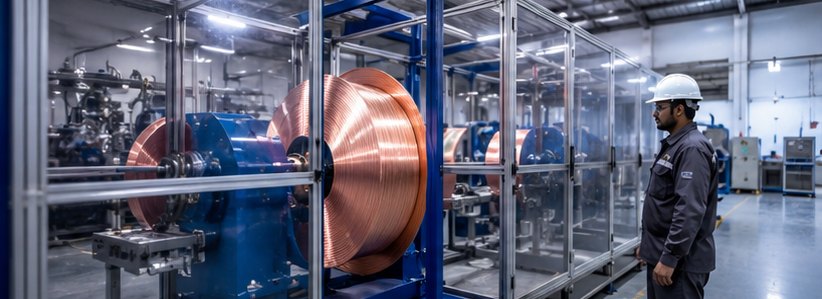
A cable line looks like a long row of machines strung across a factory floor, and that is exactly what it is. But it works only because every station moves in lockstep with the others. A single conductor threads through all of them at a controlled, constant speed, gaining insulation along the way and coming out the far end wound neatly onto a reel. Here is the chain, station by station.
1. Pay-off
The line starts at the pay-off, which unwinds the bare conductor from a supply reel and feeds it into the process. The critical requirement is smooth, constant-tension delivery: if the conductor jerks or slackens here, that disturbance travels all the way downstream. Larger lines use powered, tension-controlled pay-offs and often an accumulator so the wire keeps moving even during a reel change.
2. Wire pre-heating and straightening
Before insulation, the conductor is usually straightened and pre-heated. Straightening removes cast and helps centering at the crosshead. Pre-heating drives off moisture and warms the metal so the molten polymer bonds well and doesn’t get chilled unevenly on contact — important for adhesion and for avoiding trapped voids.
3. Extruder and crosshead
The extruder melts the compound and pumps it to the crosshead, where it is applied around the conductor as insulation or sheathing. This is the defining station of the line — the point covered in our article on what a crosshead does — and everything before it exists to deliver a clean, centred wire, while everything after exists to fix and finish the covering.
4. Cooling trough
Straight out of the crosshead, the insulation is hot and soft, so the cable runs into a cooling trough — a long water bath. Cooling is more subtle than it looks:
- It is usually graduated, from warm at the crosshead end to cold at the exit, so the insulation doesn’t quench too fast and crack or build in stress.
- The trough must be long enough for the given line speed and insulation thickness; run too fast for the trough length and the core comes out still soft.
Cooling length is one of the real limits on how fast a line can run.
5. Spark tester, printer and diameter gauge
As the cooled cable emerges it passes through inspection and finishing:
- A spark tester checks the insulation for pinholes or faults by applying voltage.
- A diameter gauge monitors the outside dimension continuously.
- An inkjet or embossing printer marks the cable with maker, spec and length.
6. Haul-off (capstan)
The haul-off, or capstan, is the muscle that pulls the whole line at a set, steady speed. It matters more than its simple job suggests, because line speed together with extruder output sets the insulation thickness: pull faster and the covering thins; slow down and it thickens. Consistent haul-off speed and tension are therefore fundamental to dimensional control. Matching the pull to the extruder, cooling and product is a core part of how cable extrusion lines are designed and balanced as a whole rather than as separate machines.
7. Take-up
Finally the finished cable is wound onto a reel at the take-up. Like the pay-off, it needs controlled tension — enough to wind a tight, even reel, but not so much that it deforms the cable. Automatic traverse lays the cable neatly across the reel, and dual take-ups allow a full reel to be swapped without stopping the line.
The thread that ties it together: tension and speed
Read back through the stations and one theme repeats: constant tension and constant speed. Pay-off, capstan and take-up must agree on how fast the cable moves and how hard it is pulled at every point, or the conductor stretches, the insulation thickness wanders, or the reel winds badly. A well-built line is really a well-synchronised one — a set of stations that behave as a single machine. That coordination, more than any individual component, is what separates a line that makes consistent cable from one that fights itself all shift.